AI-powered customer support means agents answer common customer questions, investigate issues, and take routine actions, while your team handles the judgment calls. For B2B teams, agents need account context to be useful: the customer's account details, their past issues, and what your connected systems, like the codebase, already show. In Pylon, agents investigate issues before your team opens them, using that account context.
What do agents do in customer support in 2026?
Pylon splits the work across agents. Support Agent answers customers across channels and brings in a person when judgment is needed. Assist Agent investigates issues and drafts replies for your team. Slack Agent lets sales, success, product, and engineering ask agents questions and take action from Slack. Automations run agent workflows from events or schedules, and Skills teach agents how your team investigates and resolves issues. For what an AI agent is, how it compares with a chatbot, and the full agent lineup, see What are AI agents in customer support?.
To compare platforms on context, actions, and how AI is billed, see the best agentic customer support platforms for B2B in 2026.
Agents in Pylon run on agentic credits shared across the team.
How is B2B support different from B2C support?
A B2B customer is a company. One account can have dozens of users, a contract, an SLA, and open engineering issues, and many of them reach you in shared Slack Connect or Microsoft Teams channels. Agents working B2B issues need the account history and the engineering status before they reply.
Do AI agents reduce response times?
Yes. Agents answer routine questions right away and investigate the rest before your team opens the issue. At AssemblyAI, first response time for in-app chat issues handled by Pylon's AI agent fell 97%, from 15 minutes to 23 seconds.
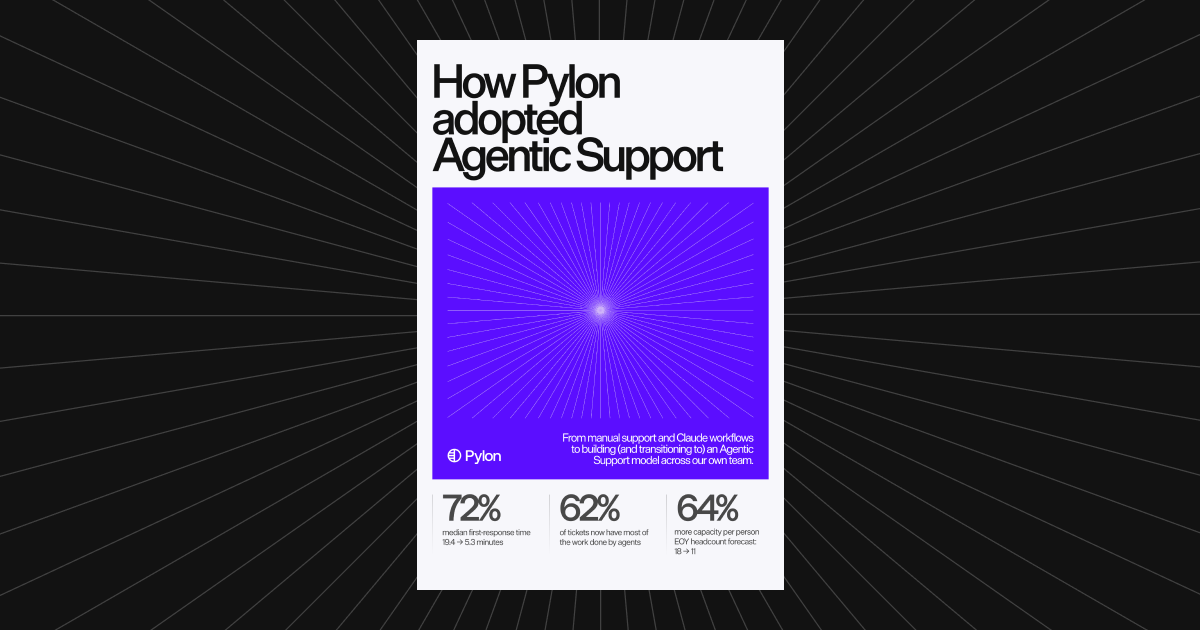
On Pylon's own support team, issues arrive already investigated, and median first response time fell 72%, from 19.4 to 5.3 minutes.
What resolution rate should you expect on L1 issues?
It depends on how much of your volume is routine and how well your knowledge base covers it. AssemblyAI started with an AI resolution rate in the high 20s and now resolves about 50% of eligible chats without a person.
At Pylon, an AI agent resolved the simple, routine questions that made up around half of incoming issues, and those issues took about 10% of the team's time. In Pylon, an issue counts as resolved when it closes while still assigned to the agent, or when it stays assigned to the agent with no new messages for more than 24 hours.
How do agents cut resolution time?
Agents do the investigation before your team starts, so people spend their time deciding, not searching. On Pylon's own team, an Automation finds the relevant ID, searches the logs, and pulls the matching log lines before anyone opens the issue, so what used to be a 30-minute investigation now takes about two minutes to review and approve.
After moving to Pylon, Sardine cut manual support hours by about 35% while issue volume grew 25%.
Can AI agents handle complex support issues?
Yes, with a person making the final call. Assist Agent investigates issues more deeply, reaches external data through Connectors, and drafts replies and suggests actions for a teammate to review.
On Pylon's own team, when an issue needs more digging, a teammate asks Assist Agent to check the relevant code paths and past issues before replying. When Support Agent can't answer, it follows your escalation workflow and reassigns the issue to your team.
Can AI agents cover nights and weekends?
Yes. AssemblyAI keeps 24/7 live chat coverage, with Pylon's AI agent handling chats through weekends and off-hours, without adding weekend staffing.
How do you roll out agents without hurting the customer experience?
- Start with one channel and one well-documented issue type.
- Connect your knowledge base and past resolved issues.
- Write Skills for how your team investigates and resolves that issue type.
- Test against real past conversations before going live.
- Make handoff to a person easy for the customer.
- Review agent answers weekly and update Skills.
How much does AI-powered support cost?
Vendors charge per seat, per resolution, per conversation, or with credits. Pylon charges per seat plus agentic credits, and there are no per-issue fees. Pricing:
- Professional: $89 per seat per month, on an annual contract
- Advanced: $139 per seat per month, on an annual contract
- Enterprise: custom pricing
Agentic features run on credits, available pay as you go or as a committed plan, and you can buy more in the product anytime.
FAQ
What is AI-powered customer support?
Agents answer routine questions, investigate issues, and run workflows. People review the hard calls.
Will agents replace my support team?
Agents take the repetitive questions and the prep work. Your team directs and reviews that work, and spends its time on complex accounts.
Can agents work in Slack?
Yes. Support Agent answers customers in Slack Connect shared channels, and Slack Agent lets sales, success, product, and engineering ask agents questions and take action from Slack.
Can I connect my own AI tools?
Yes. The Pylon MCP server and bring-your-own-agent support are on every plan.
How do you prepare to scale AI-powered support?
Grow agent coverage one issue type at a time, and test each change against real past issues with backtesting before it reaches customers. Pylon charges per seat plus agentic credits, not per issue, so costs stay predictable as issue volume grows. After moving to Pylon, Sardine supports 6x the business volume with the same size support team.
How does a unified platform improve response times?
When every channel lands in one queue, your team and agents work from the same place instead of checking Slack, Microsoft Teams, and email separately. Sardine brought more than 400 Slack and Microsoft Teams customer channels into Pylon, and after moving from Zendesk its first response time fell 90%, from 35 minutes to under 3.5 minutes.
How do you measure AI agent performance?
Track resolution rate and escalation rate alongside first response time. In Pylon, each Support Agent has Issue logs and an Analytics page that show assigned, resolved, and escalated issues and the reason for each escalation.