Updated November 9, 2026
An AI help desk is a support platform where AI agents investigate, resolve, and act on customer issues alongside your team, across the channels your customers already use.
For B2B teams, that usually means more than auto-replies. Issues often need account history, product context, and a person who can decide what happens next. A useful AI help desk keeps that work in one system: ticketing, knowledge, channels, and agents that your team can direct.
This guide covers what an AI help desk is, how it works for B2B support, what to look for when you evaluate one, and how Pylon's agents fit. It is not a ranked list of AI ticketing tools or a "best AI customer support software" roundup. For those, see best AI ticketing systems for customer support 2026 and best AI help desk and agentic support platforms.
What is an AI help desk?
An AI help desk is the help desk itself, with agents built into the same system that holds your inbox, knowledge base, and workflows. Agents can draft replies, investigate issues across connected tools, resolve common questions, and hand work to a person when judgment is required.
That is different from bolting a separate AI layer onto an older ticketing product, and different from a standalone deflector that only answers FAQ-style questions. In B2B support, customers often write in Slack or Microsoft Teams, reference a specific account or configuration, and need a path to a human who already has context.
Pylon is the agentic support platform purpose-built for B2B: humans and agents collaborate on investigating, resolving, and acting across support, customer success, and product. Pylon is trusted by 1,800+ B2B customers.
How does an AI help desk work for B2B teams?
Most AI help desks follow a similar loop, even when product names differ:
- Intake. Issues arrive from email, chat, Slack, Microsoft Teams, ticket forms, and other channels into one queue.
- Context. The system pulls what it can about the customer, past issues, and product knowledge so the next step is not a blank search.
- Action. Agents draft a reply, run a repeatable workflow, update fields, or resolve the issue when the path is clear.
- Handoff. When the work needs judgment, a person reviews, redirects, or takes over.
- Improvement. Traces, Skills, and knowledge updates feed the next similar issue.
On Pylon, that loop is powered by four agents, plus Skills that tell them how your team works. Skills are instructions, not a fifth agent.
- Support Agent resolves customer questions across channels and brings in humans when judgment is needed. You choose which knowledge base articles Support Agent can use through each article's AI agent access setting.
- Assist Agent helps your team investigate issues, draft replies, and take action with tools and context already in Pylon. It proposes drafts and actions for a teammate to review.
- Automations run repeatable workflows on an event or schedule. Set to start on new issues, agents investigate issues before your team opens them.
- Slack Agent answers product and customer questions and takes approved actions from Slack, with the same customer context and permissions as Pylon. It runs in internal channels, not Slack Connect customer channels.
Under the hood, Pylon's Nexus harness loads support, account, and product context, applies Skills and permissions, and records traces so later runs can improve. Agents only get the tools and context their configuration allows. Sensitive or consequential actions can require human approval.
Why do B2B teams need a different AI help desk than B2C deflection?
B2B issues often span multiple contacts, products, teams, and systems. Resolving them needs account history, product data, past conversations, and coordination across the company, not only an answer from a public FAQ.
That is why channel coverage and account context matter as much as "AI reply" demos. Slack Connect and Microsoft Teams are common primary channels for B2B customers. A product that only shines in a web widget will feel incomplete if your customers already live in shared channels.
If you are comparing help desks more broadly (not only the AI layer), see best help desk software and ticketing systems and best SaaS help desk software.
What should you look for in an AI help desk?
Use this checklist before you shortlist vendors. It is a buyer test, not a claim that every product passes it.
- Agents in the same system of work. Can agents work inside the same inbox, knowledge base, and account context your team uses, or are they a separate product you glue on later?
- Human control. Can you set which tools agents may use, when they escalate, and which actions need approval?
- Knowledge controls. Can you choose which articles agents may read, including internal articles agents can use as background without linking them to customers?
- Channels you actually use. Confirm Slack, Microsoft Teams, email, chat, Discord, WhatsApp, and other channels against the plan you will buy. On Pylon, Slack Connect is on every plan; Microsoft Teams and Google Chat are on Advanced and Enterprise; phone is an add-on.
- Pricing model. Prefer a model you can forecast. Pylon prices seats plus agentic credits, and does not charge per ticket. Professional is $89 per seat/month and Advanced is $139 per seat/month on annual contracts. Enterprise is a custom quote. Assist Agent, Support Agent, Slack Agent, and Automations require credits, available pay as you go or as a committed plan, and you can top up in Pylon anytime. Skills are included on every plan.
- Proof on hard work. Ask how the product handles investigations that need logs, CRM, past tickets, or codebase context, not only password-reset style FAQs.
- Security and permissions. Ask who can see what, how actions are attributed, and which compliance options apply on your plan (Pylon publishes SOC 2 Type II, ISO 27001, GDPR support, and EU data residency on all plans; see Pylon Facts and security).
How do Pylon's agents fit an AI help desk?
Pylon is the help desk: omnichannel ticketing, knowledge base, analytics, and agents in one B2B support platform. Teams move to Pylon to replace their help desk, not to add AI on top of another inbox.
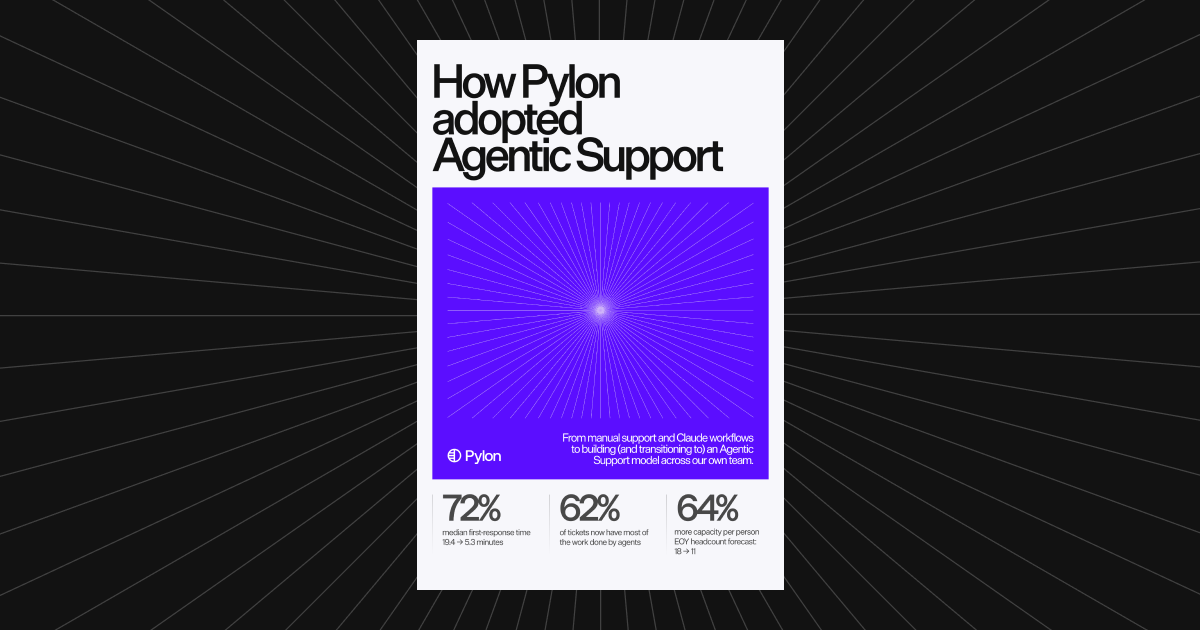
When Pylon's own support team adopted Agentic Support, median first-response time fell 72%, from 19.4 to 5.3 minutes, comparing the four weeks before rollout with the four weeks after (May 4–31, 2026 vs June 8–July 5, 2026). Ticket volume grew 3% across that period. Read the full write-up: How Pylon adopted Agentic Support.
Customer teams see similar platform outcomes when they consolidate support. Sardine cut first response time by 90%, from 35 minutes to under 3.5 minutes, after moving to Pylon, while keeping the same support team size as the business grew.
Account-level signals such as health scores live in the Account Intelligence add-on ($10 per customer account/month, minimum 50 customer accounts). Do not treat those as included on every seat plan.
How is an AI help desk different from AI ticketing or "AI customer support software"?
These phrases overlap in search, but they are not the same buying decision:
- AI help desk (this page): the platform where agents and people share one system of work for support.
- AI ticketing: often focuses on how tickets are created, classified, routed, and closed. Start with best AI ticketing systems for customer support 2026 if that is the shortlist you need.
- Best AI help desks: a ranked list of AI help desks and agentic support platforms. See best AI help desk and agentic support platforms.
Keeping those intents on separate URLs helps readers (and search) land on the page that matches the question they asked.
FAQs
What is an AI help desk?
An AI help desk is a support platform where AI agents investigate, resolve, and act on customer issues alongside your team, inside the same system that holds your inbox, knowledge, and workflows.
How is an AI help desk different from a chatbot?
A chatbot is usually limited to scripted or FAQ-style deflection in one channel. An AI help desk puts agents inside the full support platform so they can use account and product context, take approved actions, and hand off to people when judgment is required.
What agents does Pylon include?
Pylon includes Support Agent, Assist Agent, Automations, and Slack Agent. Skills teach those agents how your team works; Skills are not a fifth agent. Agentic features run on credits.
Does Support Agent use every knowledge base article?
No. You choose which knowledge base articles Support Agent can use through each article's AI agent access setting. That setting is separate from article visibility.
How is Pylon priced for an AI help desk?
Pylon is priced by seats plus agentic credits, not per ticket. Professional is $89 per seat/month and Advanced is $139 per seat/month on annual contracts. Enterprise is custom. Assist Agent, Support Agent, Slack Agent, and Automations require credits. See pricing.
Can agents investigate issues before my team opens them?
Yes, when you configure Automations to start on new issues. Agents then investigate using the context and tools you allow, and your team reviews the findings.