An agentic AI platform is software that lets you direct AI agents to investigate, use tools, and take permitted actions, with oversight and guardrails. In B2B support, the platform has to carry account context across Slack, email, chat, and ticketing, not only answer a single FAQ.
Pylon is the agentic support platform built for that work. Trusted by 1,800+ B2B customers.
What is an agentic AI platform?
In a traditional help desk, people research each request, coordinate with other teams, and reply, maybe with light automation. On an agentic AI platform, you assign agents to parts of that work.
Example: a customer asks for help with an integration. An agent loads knowledge base articles, past issues, and permitted account configuration, then proposes next steps and a draft reply. Your team accepts, asks for more investigation, or takes over.
Nexus is Pylon's agent harness: context, memory, traces, routing, guardrails, and improvement around the models (Nexus). That scaffolding is what makes agents useful on real customer workflows.
An agent is the worker. The platform is the system that hosts agents, permissions, tools, and audit history. For the agent definition, see What are AI agents in customer support?.
What capabilities should an agentic AI platform have?
Needs vary by use case. For B2B support, require:
- Multiple agents with clear jobs. Customer-facing resolution, on-demand investigation, triggered workflows, and internal chat agents should be separable. See Types of AI agents for support teams.
- Deep system connections. Knowledge base, CRM, billing, issue trackers, and your own APIs. MCP support helps agents and external tools share the same actions (MCP guide).
- Oversight and traces. You should see what the agent checked, what it tried, and what it wants to change.
- Governance. Spell out autonomous vs approval-required actions. Simple product questions can resolve. Billing changes and destructive actions should wait.
- Flexible model and tool support. Models change. Platforms that connect through MCP and custom actions age better.
- Reusable workflows. Skills or equivalent instructions so agents do not reinvent the same procedure every time.
Connect external tools into your workflows via outbound Connectors or bring ChatGPT, Claude, and Cursor to your workspace with the Pylon MCP server, and see how AI agents work in customer service for a comparison of agents, chatbots, and copilots.
What types of agentic AI systems exist?
| Type | What it is | Examples (category only) |
|---|---|---|
| General-purpose enterprise platforms | Build agents for many business functions in one place | Salesforce Agentforce, Microsoft Copilot Studio |
| Purpose-built agentic platforms | Depth in one domain | Pylon for B2B support, Harvey for legal, Rogo for finance |
| Developer frameworks | Code-first agent construction | CrewAI, AutoGen |
| No-code automation tools | Visual builders for simpler workflows | Zapier, n8n |
General-purpose tools fit broad task automation. B2B support usually needs purpose-built depth: multi-stakeholder accounts, Slack Connect and Teams threads, engineering escalations, and long account history.
How do you choose for B2B customer support?
Score vendors on account context, actions and approvals, real customer channels, human handoff quality, and cost at 1× and 2× volume. Bring five real issues to every demo. The full method is in How to evaluate an agentic support platform. For a shortlist, see Best agentic customer support platforms for B2B in 2026.
How Pylon's agents map on the platform
From Pylon Facts:
- Assist Agent: investigates and acts for your team.
- Automations: repeatable workflows on an event or schedule. With Automations set to start on new issues, agents can investigate before your team opens them.
- Support Agent: works on customer questions and brings people in when judgment is needed.
- Slack Agent: answers and acts from Slack with the same context and permissions (internal channels only).
- Skills: reusable instructions for a scenario. Skills are included on every plan.
Also on every plan: Pylon MCP server, MCP connectors, custom API actions, and bring your own agent.
Pricing on an agentic support platform
Expect seats plus an AI usage model (credits, per conversation, per resolution, or per outcome). Pylon is seats plus credits, with no per-issue fee. Professional is $89 and Advanced is $139 per seat per month on an annual contract. Enterprise is custom. Assist Agent, Support Agent, Slack Agent, and Automations use credits. Credits are available pay as you go or as a committed plan, and you can top up in Pylon anytime.
Read How agentic support is priced before you compare quotes.
Proof from teams already on agentic support
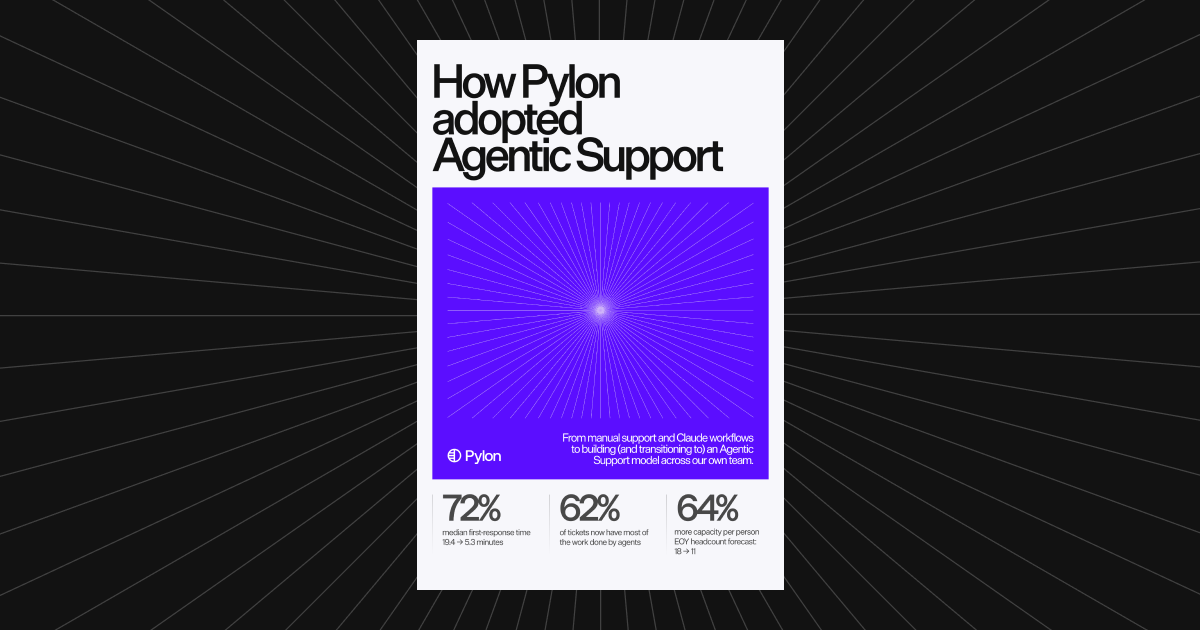
Pylon's own team: median first response time down 72% (19.4 to 5.3 minutes), and 62% of tickets involving substantive agent work (ebook).
AssemblyAI: 97% reduction in in-app chat first response time (15 minutes to 23 seconds) for issues handled by Pylon's AI agent, about 50% of eligible chats resolved without a person, and 2x improvement in AI resolution accuracy (case study).
FAQ
How do I get started with an agentic AI platform?
Define one repetitive workflow in plain language, often as a Skill. Run it with review on. Expand only after that path is reliable.
Can beginners use agentic AI platforms?
Yes. Purpose-built platforms let you direct agents without writing application code. You still need to know your support workflow well enough to set permissions and escalation rules.
What is the difference between generative AI and agentic AI?
Generative AI creates content from a prompt. Agentic AI also takes actions: look something up, update a record, or complete a multi-step task under guardrails.
What is agentic AI in plain terms?
AI that can pursue a goal with tools and steps, not only return text. In support, that means investigating an issue and acting within the permissions you set, while people handle judgment calls.
How is an agentic AI platform different from a single AI agent?
A single agent does one job. A platform hosts multiple agents, shared context, tools, permissions, traces, and pricing across the team.